How Vedic astrology (Jyotish) can explain the premature deaths of Amy Winehouse, Kurt Cobain, Jim Morrison, and others.
In the early 1970s, an urban legend known as the “Club 27” appeared in mainstream media. It referred to a group of people, mostly musicians, who died at the age of 27. The causes of their early deaths varied, but most often involved alcohol or drug overdoses, suicide, or death under mysterious circumstances.
The first “members” of the club included Jim Morrison (lead singer of The Doors), Jimi Hendrix, Janis Joplin, Brian Jones (founder of The Rolling Stones), and Robert Johnson. Over time, Kurt Cobain and Amy Winehouse “joined” them. Over the past 50+ years, the list has grown, and you can find the most famous representatives on this page. It is important to note that this phenomenon has no scientific confirmation and is considered an urban legend.
However, Vedic astrology offers a clear explanation for the premature deaths of these musicians, and it is directly connected to the lunar nodes Rahu and Ketu and their transits.

Disclaimer: I do not claim to make any sensational statements, scientific claims, or medical diagnoses. Everything presented below is purely astrological theory, analysis, and interpretation.
Contents:
- The Role of Rahu and Ketu
- Transits
- Exhibit A: Jum Morrison
- Exhibit B: Amy Winehouse
- Exhibit C: Kurt Cobain

The Role of Rahu and Ketu
To explain this phenomenon, we need to understand the nature of the lunar nodes Rahu and Ketu, as well as their transits.
Unlike other planets, Rahu and Ketu do not have the status of devatas (deities). Their nature is demonic: they belong to another dimension but managed to “seep” into ours and received the status of grahas (sanskrit for “seizers of consciousness”) alongside the Sun, Moon, Mercury, and other planets. Within us, they represent inner demons whose goal is to destroy us. This is the first key to understanding them.
Внутри нас они олицетворяют внутренних демонов, чья цель — разрушить нас. Это первый ключ к их пониманию.
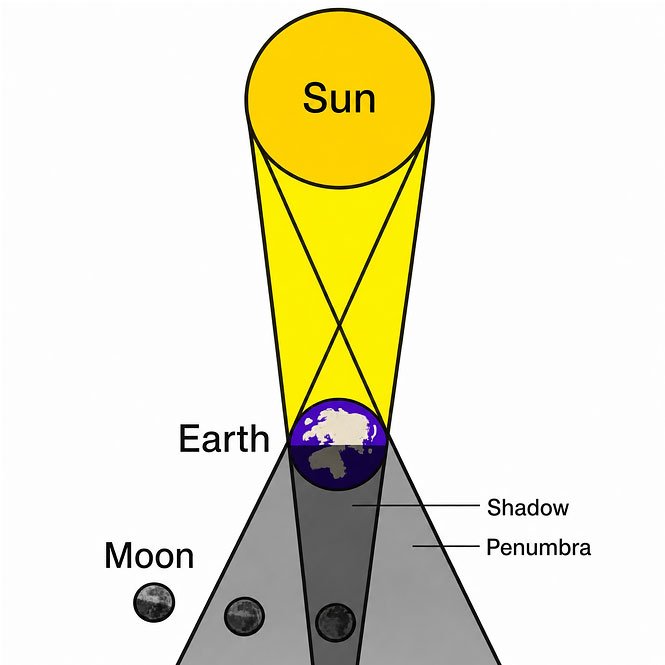
Rahu and Ketu are in naturally hostile relations with the Moon and the Sun. The reason lies in their origin. Originally they were a single being named Svarbhanu, but they were divided into Rahu (the head) and Ketu (the body) because of the Sun and the Moon. Therefore, these grahas seem to hunt the Sun and Moon, eclipsing them twice a year. Astronomically, we see this as solar and lunar eclipses.
The Moon and the Sun symbolize different parts of our consciousness. The Moon represents our perception of the world and inner processes, while the Sun represents our spirit and realization in the external world. When Rahu and Ketu “swallow” them during an eclipse, we lose touch with ourselves and the mind becomes clouded: it becomes harder to perceive reality, and behavior turns “inadequate.” This is the second key to understanding their nature.
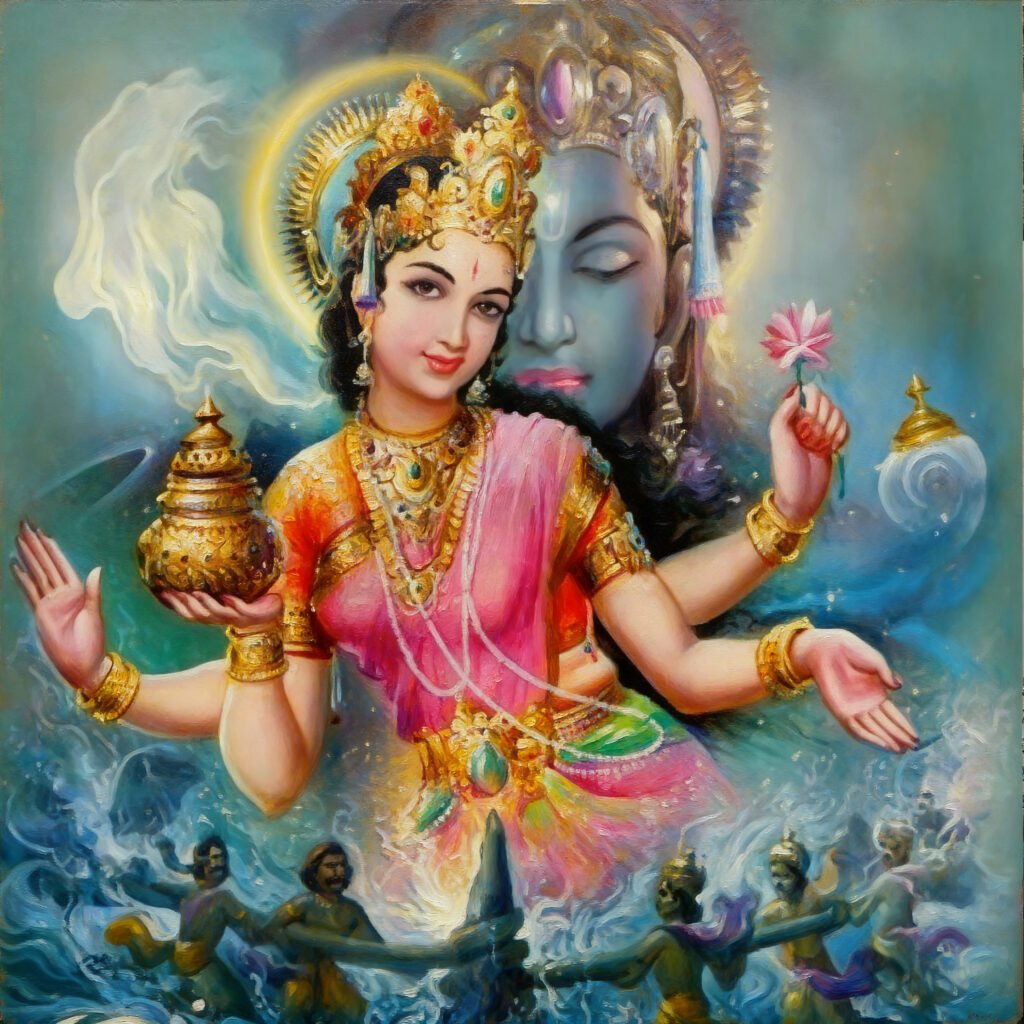
In the myth of the origin of Rahu and Ketu, the main attribute was amrita — the nectar of immortality that the demon tried to obtain. For him, it meant going beyond the possible: overcoming the boundaries of life and the death of the demonic body.
Alcohol and psychoactive substances carry similar symbolism, though with a demonic shade: they take one away from reality, provide intense sensations, and blur the boundaries of what is possible. That is why Rahu and Ketu are associated with addictions. This is the third key to understanding them.
Finally, in the horoscope, the position of the nodes indicates the trajectory of the soul’s development from past lives into the current one. Ketu symbolizes accumulated experience and “body memory,” while Rahu represents bold desires and aspirations that brought the person into this incarnation. They represent the polarity between the past and the future.
Strong manifestations of Rahu and Ketu in a person’s life can be expressed in these ways:
- ЗAbuse of alcohol and psychoactive substances — as a way to escape reality and expand the boundaries of the possible.
- Mental disorders — as a clouding of the mind (severe forms of anxiety, depression, bipolar disorder, etc.).
- Belonging to marginal groups, outsiders, or occult circles — Rahu and Ketu are “strangers” by nature.
- Tendency toward self-destruction — as a manifestation of the darkest parts of our consciousness, our inner demons.

Transits
Rahu and Ketu have no physical bodies; they exist only as coordinates on the celestial sphere. They are always located exactly opposite each other on the zodiac wheel and move as a pair, changing their axis of signs every one and a half years.
A full cycle of Rahu and Ketu transits takes approximately 18–19 years. This is also reflected in a person’s life: their return to the same positions as in the natal chart symbolizes the beginning of a new life cycle, pushing the person toward new roles and tasks. For example, at the age of 18–19, many people first leave their parents’ home and begin independent life.
There is also another important transit. In the middle of the cycle, around the 8.5–9.5 year mark, Rahu and Ketu take opposite positions: Rahu moves to where Ketu was, and Ketu to where Rahu was. This transit can be called the uroboros (a snake biting its own tail) — and that is how this article will refer to it going forward.

Rahu and Ketu’s Movement Through the Houses of the Natal Chart: The Ouroboros Transit
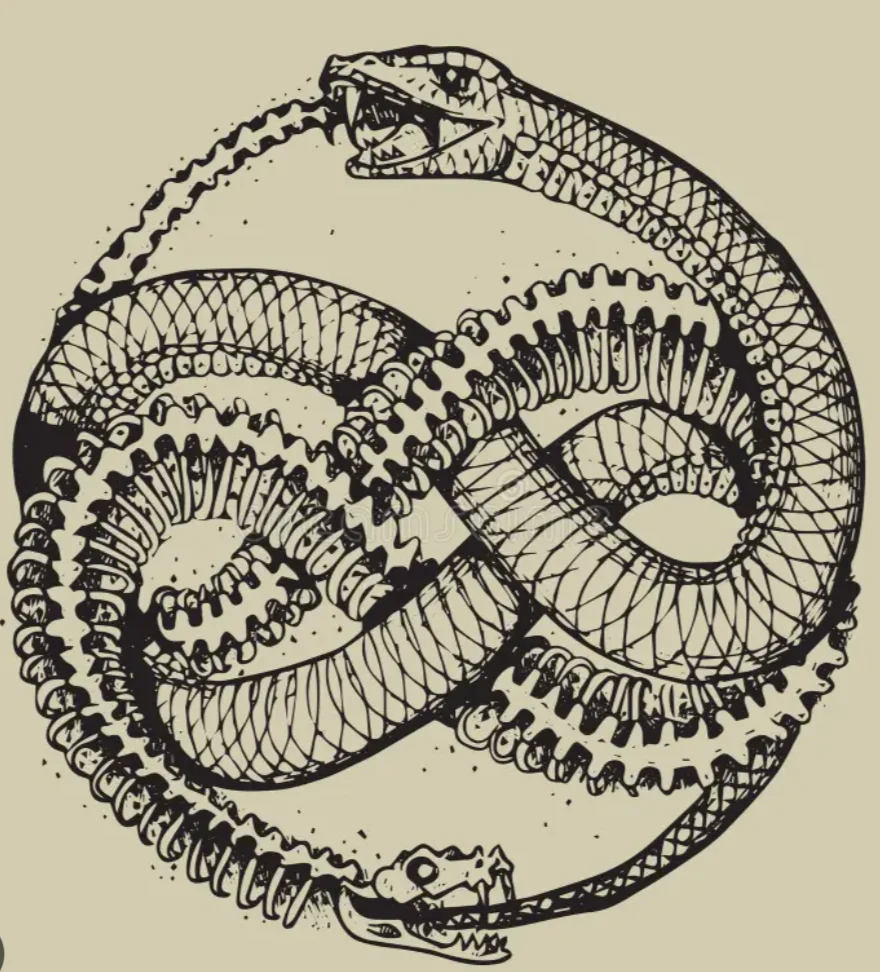
The Ouroboros as a Symbol of Cycles and Rebirth
The uroboros occurs at ages 27, 45, 63, and so on. It triggers a kind of “life review”: a person gets the chance to rethink past experience and see new paths of development. It is often accompanied by deep inner transformation, when situations or scenarios related to the areas affected by the nodes repeat. The person’s task is to recognize them and transform them in order to move forward on the path of their evolution.
However, some souls carry too strong an influence from the past — through the nodes or retrograde planets in the birth chart. In that case, during the uroboros transit, they simply cannot cope with its challenge and may leave the body. This is also part of their karma: by leaving the body, they continue their journey in new incarnations with a different karmic baggage, possibly less connected to the influence of Rahu and Ketu. This is how the evolution of their souls occurs.
Returning to the “Club 27.” All its members died at exactly 27 years old — that is, during the uroboros transit — which confirms this astrological theory. In the next part of the article, I will examine their birth charts through this lens:
- Influence of the nodes Rahu and Ketu (both static and in transit);
- Signs of alcoholism and addictions;
- Indicators of mental disorders;
- “Rebellious,” anti-mainstream spirit;
- Tendencies toward self-destruction.

Exhibit A: Jum Morrison
Jim Morrison is one of the first figures of Club 27. He was the charismatic vocalist of The Doors, whose popularity peaked in the late 1960s.
Their music set a new direction for rock culture, shifting it toward a dark and melancholic psychedelic sound, which largely symbolized the cultural sunset of the hippie era.
Jim was known not only for his melancholic lyrics but also for his self-destructive lifestyle. The official cause of his death is considered to be a heart attack caused by a drug overdose.
Some interesting facts from Morrison’s biography:
The use of psychotropic substances greatly influenced Morrison’s creativity: mysticism and shamanism became part of their performances. In one of his poems, he calls himself the Lizard King — a reference to occult practice. The singer saw himself as a shaman and a guide to altered states of consciousness..
He once mentioned to the members of The Doors that they might be talking to the “third member of Club 27” when discussing the earlier deaths of Jimi Hendrix and Janis Joplin.
The name of the band The Doors was taken from Aldous Huxley’s book The Doors of Perception — a reference to the use of psychedelics.

The abuse of psychedelics, “foreseeing” his own departure as a member of Club 27, interest in shamanic practices and occultism, as well as a tendency toward self-destruction — all of this points to a strong influence of the nodes Rahu and Ketu on Jim. Let’s now look at his birth chart and how it may connect his departure with the fateful influence of Rahu and Ketu.
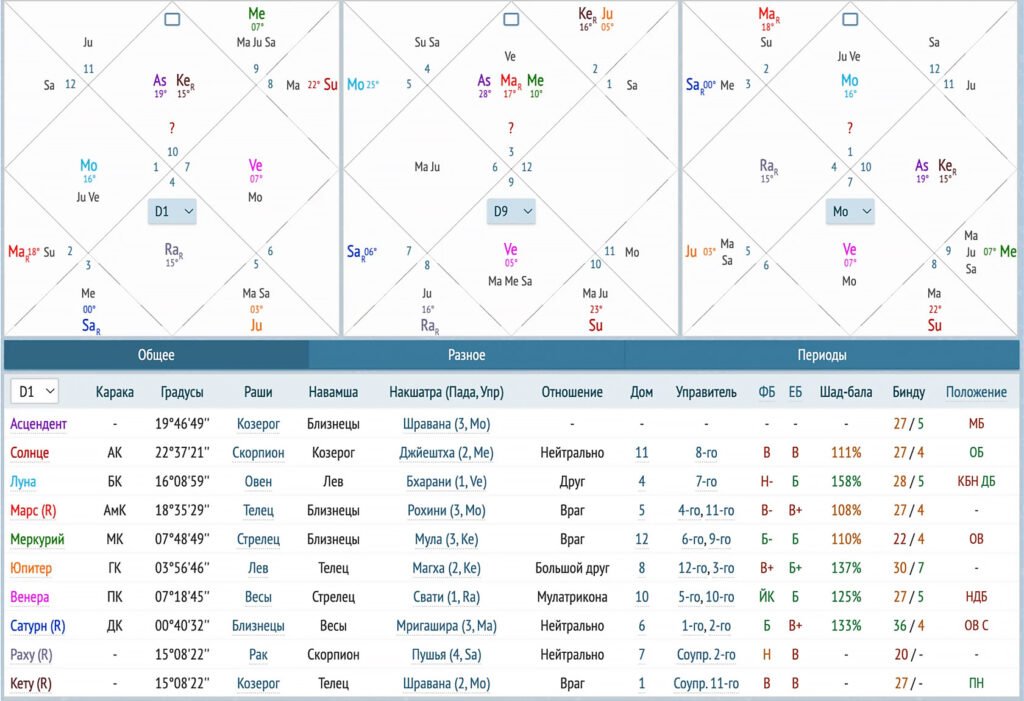
The first thing that stands out is the nodes Rahu and Ketu on the 1–7 house axis. This indicates a strong influence of the nodes on the personality. Ketu is only 2 degrees from Jim’s Ascendant and noticeably affects his health, character, and behavior. It is closely connected with psychedelic substances, as it helps one escape from reality.
However, the position of the nodes alone is not enough. Many people have this configuration, but Jim’s predestined fate was amplified by a whole range of additional factors. This is evident from the numerous connections of retrograde planets with key points of the chart — the Ascendant, Moon, Sun, and Saturn as the ruler of the horoscope. Retrograde planets, similar to Rahu and Ketu, add elements of fatality and predetermination to his life.
Among them:
- Retrograde Saturn as the ruler of Jim’s horoscope — not directly connected with the nodes, but shows a close connection of the soul with the past.
- Benefics (Jupiter, Venus, Mercury) in the nakshatras of Rahu and Ketu (Magha, Swati, and Mula respectively). Jim’s bright sides of consciousness manifested through the influence of the nodes.
- The Moon as the dispositor of Rahu in the lagna of the Moon chart; the “lagna lord” of the Moon chart is also retrograde (Mars).
- Retrograde Mars — dispositor of the personal points of the Moon (in Aries) and the Sun (in Scorpio), rules the 8th house in the Moon chart, which is connected with the person’s longevity. In Navamsa, Mars retrograde in the lagna conjoins with the Navamsa lord Mercury and is the dispositor of Rahu.
- Retrograde Saturn in Navamsa rules the 8th house and the Sun.
Such a large number of indicators suggests that Jim came into this incarnation to pay for past actions, and his fate was largely predetermined.
His interest in the occult and shamanic rituals also has astrological confirmation: the influence of the nodes, Mercury in Mula, and the Sun in Jyeshtha — nakshatras associated with shamanic practices.
As for alcoholism and addiction, the nodes and Saturn (ruler of the 1st and 2nd houses in Mrigashira nakshatra) are important here. The tendency toward self-destruction is strengthened by the influence of 6th, 8th, and 12th houses, as well as the Sun’s connection with the 8th house in Jim’s various charts.
In the Rasi birth chart, the Sun rules the 8th house and is in the destructive part of Scorpio; in the Moon chart and Navamsa it is also in the 8th house — in Navamsa already in Capricorn.
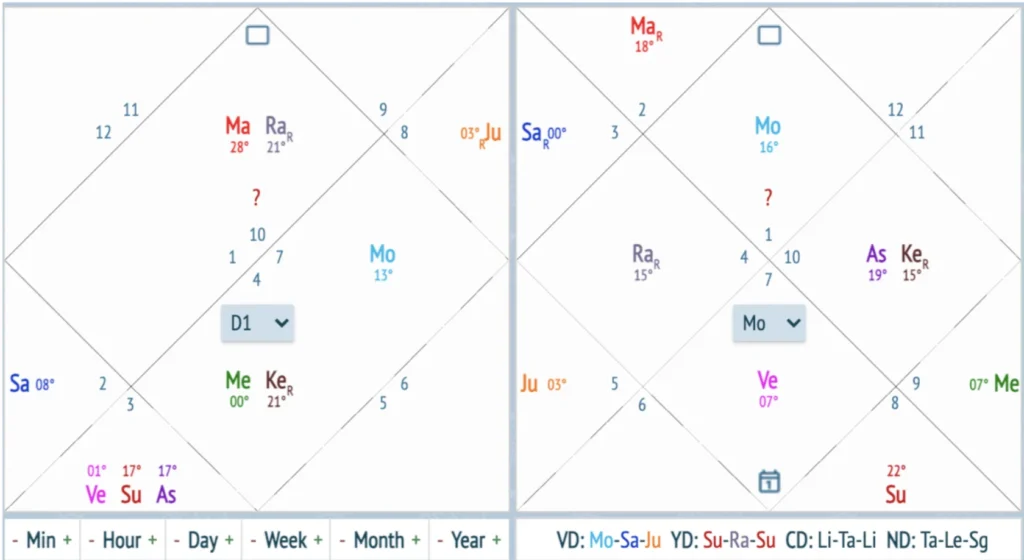
Jim passed away during the Moon–Saturn–Jupiter period. According to the official version — a heart attack after an overdose; before death, vomiting with blood and nosebleeds were noted.
The heart is ruled by the 4th house and the Sun, and he was in the major period of the Moon in the 4th house. Jupiter in Leo (ruled by the Sun) is closely connected with the 8th house, which reflects the corresponding karma. The nose and mouth, connected with the 2nd house and Saturn, manifested painful conditions.
All of this coincided with unfavorable transits: the uroboros, where Rahu was passing close to the Ascendant and natal Ketu (within 5 degrees), Sade-Sati, which often threatens health, and it was also passing over Mars retrograde connected with the 1st and 2nd houses of the Moon chart. Such a combination of unfavorable factors was undoubtedly dangerous to his life and played a role in its premature end.
Rest in peace, Jim Morrison <3

Exhibit B: Amy Winehouse
A talented British singer who performed in soul, jazz, and R&B genres.
In addition to music, Amy was known for her scandalous lifestyle, rebellious appearance and behavior, and extremely unhealthy relationship with her ex-husband Blake. It is widely known that she suffered from alcohol addiction and regularly used substances.
She was also diagnosed with anxiety, bipolar disorder, and other mental illnesses. This even found expression in her work — Amy’s most famous hit “Back to Black” contains the line “You go back to her, and I go back to black.”
The song’s lyrics refer to her breakup with her husband and her descent into darkness — a metaphor for depression, alcoholism, and even heroin (whose street name is “black”).
Amy passed on July 23, 2011. The official cause of death was alcohol poisoning.
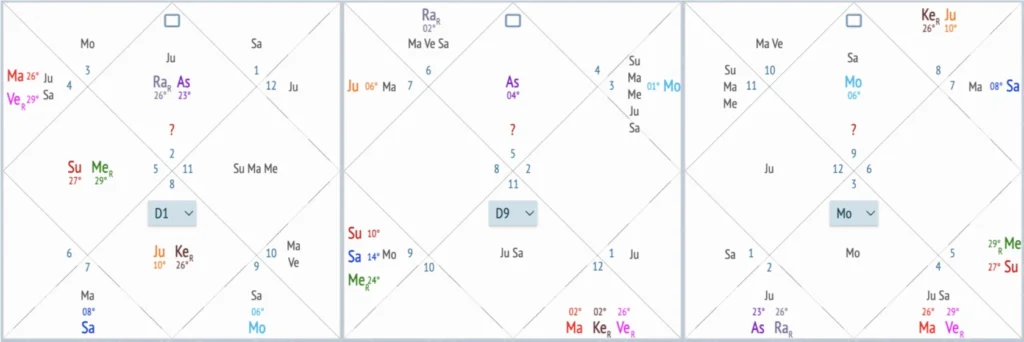
Now let’s examine her birth chart.
Amy was born under the very strong influence of the nodes Rahu and Ketu, located on the 1–7 house axis. In addition, the nodes influence her big 3 — her Moon is at the beginning of Sagittarius in Mula nakshatra, ruled by Ketu. In Navamsa, the lagna lord Venus also stands on the Rahu/Ketu axis, which further strengthens their impact.
Venus deserves special attention. It is retrograde, serves as both the ruler of the horoscope and Amy’s Atmakaraka (soul planet). Venus is the dispositor of Rahu and is located in a gandanta — a dangerous transition from a water sign to a fire sign. This combination indicates the soul’s conscious choice to live a difficult incarnation with the redemption of past karma and explains the fatalistic and rebellious tone of her life.
Separately, it is worth noting the unfavorable distribution of planets: benefics in weak houses, and malefics in kendras and trikonas. This strengthens the theme of working off negative karma rather than receiving blessings.
As for addiction:
her horoscope indeed contains many factors that may signify substance abuse.
Among them:
- Strong influence of the nodes on the personality.
- Ascendant in Mrigashira nakshatra, which gives a love of drinks; Rahu only 2° from the Ascendant strengthens the tendency toward addiction.
- Venus, the ruler of the chart, in the last degrees of Cancer in Ashlesha nakshatra, associated with poisons and intoxication.
- Retrograde and combust Mercury as the ruler of the 2nd house, which may indicate the use of alcohol and substances, as well as eating disorders (it is known that she suffered from an eating disorder).
- Dominance of the water element (two planets each in Cancer and Scorpio).
- Moon in the 8th house — gives a craving for the forbidden and self-destruction, constant inner tension. This can lead to a desire to relieve stress with alcohol.
- In the chart from the Moon, the ‘’lagna lord’’ Jupiter is conjunct Ketu in the 12th house in Scorpio.
- Prominence of the 6th, 8th, and 12th houses — not a direct indicator of addiction, but emphasizes the feeling of life as a struggle and a tendency toward self-destruction.
- In Navamsa, the 8th house and Pisces sign are prominent — another hint at alcohol addiction.
Amy left her body during the uroboros transit and under unfavorable planetary periods.

Uroboros Transit
At the time of Amy’s death, Ketu was only two degrees from her natal Rahu and conjoined with Mars within one degree. At the same time, Mars was in its ‘’dead degree’’ and was the ruler of the 12th house of losses.
Planetary Period
Amy passed during her Sun–Mercury–Jupiter period sequence.
- Mercury in her chart rules the 2nd house. Since poisoning implies consumption, this emphasizes the role of the second house in this tragic event. Alcohol poisoning was not accidental. In addition, Mercury rules the nervous system and during its period intensified her mental problems, including bipolar disorder.
- Jupiter in the natal chart is conjunct Ketu and stands in a ‘’dead degree’’. In the chart from the Moon, it rules the body and health, being in the 12th house. At the time of death, Jupiter in transit was in Aries — the 12th house from her ascendant, which highlights the theme of departure.
- The Sun in her chart rules and is placed in the 4th house, conjunct Mercury (ruler of the 2nd house), while Jupiter is in the 7th house. The 2nd and 7th houses carry the status of maraka houses and during their periods pose danger to a person’s health and life.
Intuition and Premonition
A strong connection of the nodes with personal points often gives a person developed intuition, as if they have access to information from the subtle plane. Shortly before her death, Amy confessed to her producer that she felt she would die young.
Even in the previous example with Jim Morrison, he had a similar “premonition” — and we saw that the nodes also had a very strong influence on his personality.
I hope Amy’s soul has found peace and will return to this world in a more serene state.

Exhibit C: Kurt Cobain
Kurt Cobain is a cult rock figure and the frontman of Nirvana, who became a symbol of the grunge era of the 90s.
He suffered from drug addiction and committed suicide on April 5, 1994. In his suicide note, Kurt wrote about deep depression, feelings of guilt, and loss of joy from music.
There is evidence that from a young age he dreamed of becoming a rock star and leaving life young, at the peak of fame — like Jimi Hendrix, who had previously also entered the “Club 27”.
Let’s see what Cobain’s birth chart says about such inclinations and what role Rahu and Ketu played in it.
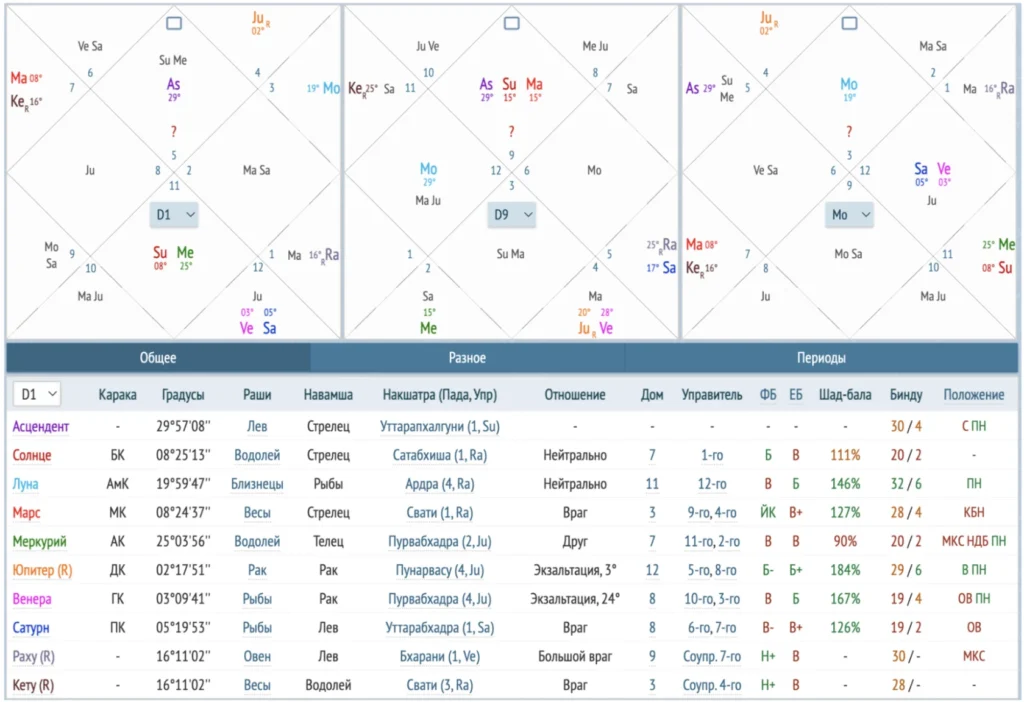
First of all, both Kurt’s Moon and Sun are located in Rahu nakshatras — Ardra and Satabhisha. Since Cobain is Leo rising, the Sun is the ruler of the entire chart, which even more strongly connects his personality with the energy of Rahu. Rahu itself aspects the ascendant, and Ketu is conjunct Mars, which is also in a Rahu nakshatra — in Libra.
It is important to clarify: Mars does not so much describe Kurt’s personality as his actions. His well-known outbursts of rage and uncontrollable anger are a direct reflection of the conjunction of Mars and Ketu.
The picture is complete seeing that Rahu is located in Bharani nakshatra, whose deity is associated with the cycle of death and rebirth. Natives of Bharani often acutely feel their mortality and believe that their life should end at a certain moment. For Cobain, this manifested quite literally.
In Kurt’s chart we see the same pattern as in Amy Winehouse’s, but even more pronounced: malefics occupy angle and trine houses, while benefics have gone into trik houses. Moreover, this trend repeats from the Lagna, from the Moon, and in Navamsa. Such a layout leaves no doubt: Kurt came into this incarnation not for carefree enjoyment of life.
Tendency Toward Self-Destruction
There are enough indicators of self-destruction in Kurt’s chart:
- Strong influence of the nodes on the personality, described above;
- Prominence of the 8th and 12th houses;
- Connection between the 1st and 8th houses — the dispositor of the Sun (as ruler of the horoscope), Saturn, goes into the 8th house.
In Navamsa, the 1st house ruler Jupiter also falls into the 8th house, and the 12th house ruler Mars falls into the 1st. This brings crisis, tension, detachment, and at the same time a craving for self-destruction into the sphere of personality.
The last important detail is revealed through the planetary period analysis at the time of Cobain’s death. If we take Saturn’s house (as the ruler of the current period) as the 1st, the following picture emerges:
- Saturn in the lagna brings energies of detachment and departure (as ruler of the 12th house);
- The 8th house ruler turns out to be Venus, also located in the period lagna;
- In the 8th house itself we see Mars conjunct Ketu. At the same time, Mars is the ruler of the 2nd house and dispositor of Rahu, and its affliction directly indicates addictions.
In addition, the ruler of the temporary lagna is retrograde, which strengthens the influence of past life karma precisely during this period of Kurt’s life.
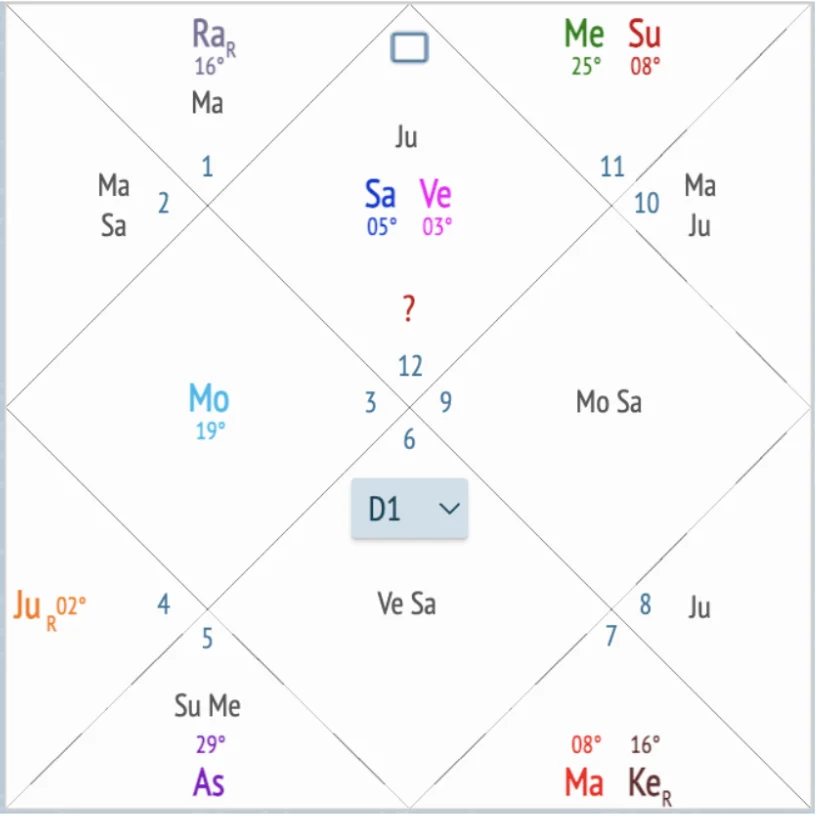
Interestingly, despite such a strong destructive background, Kurt’s personality during this period was extremely powerful: the ruler of the temporary lagna, Jupiter, was in the 5th house, exalted and vargottama. This confirms his remarkable creative success and influence achieved in those years.
Disillusionment with Success
The main key to understanding Kurt Cobain is his inner conflict. He was torn between rejecting the enormous fame that overtook Nirvana and enjoying the rock star lifestyle brought by this fame.
Kurt despised the fact that his work had become mainstream — because it was created for marginals and outsiders. He himself was part of the rebellious subculture, but in the end inspired those who laughed at outcasts to appropriate their image. This seemed to him like living a huge lie: crowds of fans did not understand the meaning of his songs but simply followed an idol.
Being an outcast was very important to Kurt. His Sun, the ruler of the chart, is in the 7th house in Aquarius — the sign of like-minded people and marginal communities. The 7th house also symbolizes the audience and the public. The Sun conjoins Mercury, which rules the 11th house of popularity, which contributed to Cobain’s fame through the image of “an outcast who became an idol.”
But this was also the paradox: his anti-mainstream message made him super popular, and anything that achieves great fame inevitably becomes mainstream. Hence Cobain’s deep disillusionment with success.
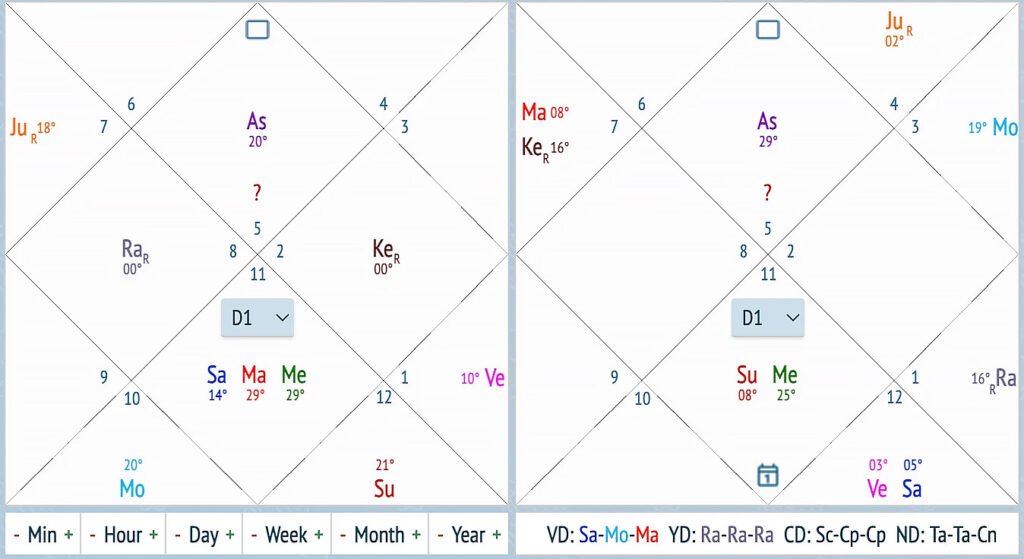
His planetary periods also played a strong role. At the time of his death, he was in the Saturn–Moon period. Both planets are connected with a heavy psychological state: Saturn by nature inclines toward depression, and the Moon in Ardra nakshatra intensifies inner crises and emotional pressure. It is not surprising that during these years his depressive episodes became more and more frequent.
Earlier, during the Saturn–Venus period, Nirvana rapidly rose to fame: in 1989 the debut album was released, and in 1991 the legendary Nevermind came out featuring lead singles that made the band world-famous: Smells Like Teen Spirit and Come As You Are. Saturn, ruler of the 7th house of reputation, in conjunction with powerful Venus brought Kurt incredible success — and with it, disillusionment. Saturn is in the 8th house in Pisces. Its task is to show a person the temporality of everything and develop non-attachment to the material. The more tangible and material Kurt’s success became, the more he saw his success – and existence – pointless.
Nirvana – Smells Like Teen Spirit
Nirvana – Come As You Are
In his suicide note, he quoted Neil Young’s lines: “It’s better to burn out than to fade away.” Kurt chose to leave at the peak of fame, as a legend, leaving behind a legacy into which he had poured his soul. One can assume that, having lost meaning in his work, he did not want to turn into a distant echo of himself.
I hope Kurt Cobain’s rebellious soul has found peace and can continue moving along the path of its evolution.
From the research above, it is clear that the “Club 27” is not just a coincidence or an urban legend, but a pattern associated with the cyclic manifestation of the lunar nodes Rahu and Ketu in the lives of these people.
If we look at this phenomenon more broadly, we can rather speak of the “Club 27–29,” since it is at these ages that a person experiences their first uroboros — a special point of intersection of fate.
In addition, the research can be continued by including the years of full nodal returns and subsequent uroboros transits. In that case, the list of “victims” of this cycle would be much wider: it could include Avicii, Mac Miller, Heath Ledger, Matthew Perry, Julian McMahon, and many others.
Perhaps one day I will prepare a more detailed study on this topic.